HES Faculty Awarded DELTA Grants to Improve Online Course Offerings

As the world of higher education marches forward into new frontiers in the realms of technology and online learning, NC State’s Department of Health and Exercise Studies (HES) continues to search for new ways to improve its course offerings for students. HES is home to one of the largest, comprehensive physical activity instructional programs in the nation.
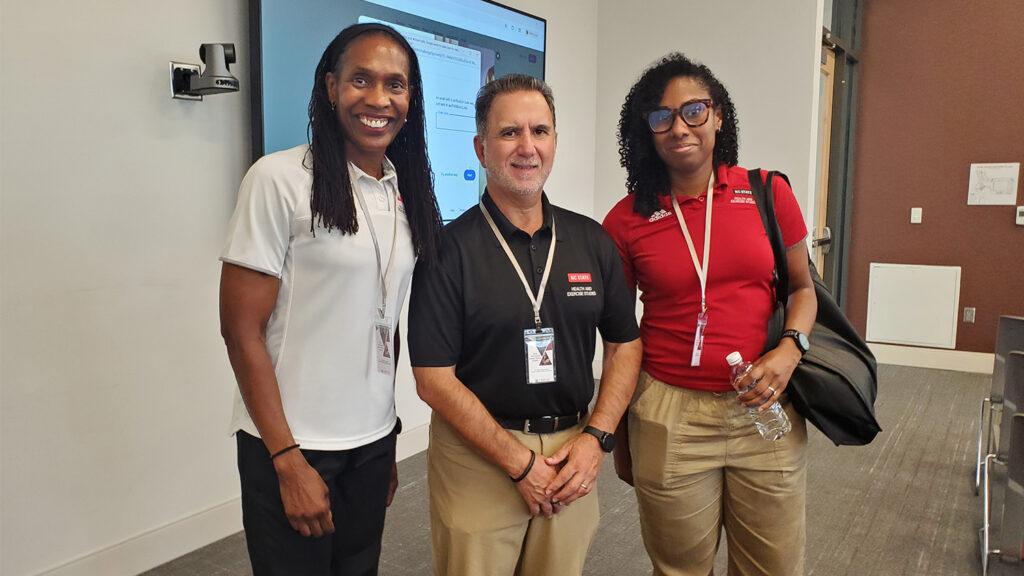
Several HES faculty members recently received a major boost to their course improvement objectives, with Joanna Stegall, Peter Koutroumpis, Jerry Loflin and Ashley White all receiving DELTA Grants.
“Part of our vision and mission is to be innovative, especially in these types of classes,” said Amy Knab, HES’ department head. “I think it’s important, because technology is always changing, as well as student needs. And our faculty are always seeking ways to improve their pedagogy.”
The DELTA Grants provide support, key services and financial resources to increase student success through faculty partnerships, giving the faculty who receive these grants access to a collaborative DELTA team, the DELTA staff’s expertise in instructional design and financial resources to use for personnel, conferences, new equipment and software and more.
“I love working with DELTA,” White said. “I’ve worked with them on other grants. I’ve learned so much from them, especially about how to improve my online courses. So I’m really grateful for the opportunity.”
Quality Matters
For the majority of her 16 years with NC State, Stegall has been teaching HESF 100, also known as Cross Training. This course is unique in that, unlike most HES course offerings, it’s a two-credit hour course that allows students to fulfill their HES General Education Program (GEP) requirements in one course.
The course combines activities such as running, indoor cycling, mind and body stretching exercises and weight training.
“I think the value for me and for them is that I get to see them three times a week,” Stegall said. “Just having that extra day with them, I think it’s a good experience with teacher-student connection, and then getting that variety of different activities. This is the stuff I want them to experience, because when they step away from college, they’re going to be out in the world. When they have to plan their own exercise routine, they’ve done a lot of different activities that they can choose from.”
After receiving an $8,000 Course Improvement Grant from DELTA, Stegall will have the opportunity to spend the 2025-26 school year refining the online version of the course for students.
She will go through the Quality Matters certification process for the course. Faculty members going through this process complete a Quality Matters workshop, in which they learn all of the organization’s standards for ensuring the quality of an online course, and then apply it to their course to ensure that learning objectives, course objectives and module objectives all align.
Quality Matters standards also improve the course’s technology offerings, as well as its accessibility to all populations, and the quality and variety of assessments for students.
“I’m excited. It’s a lot of work, but I know it’s going to be worth it,” Stegall said. “It’s good to have that stamp of certification on any course, because people see that and say ‘Someone’s put some time into that. They’ve put in some effort.’”

Koutroumpis has already seen and felt the value of Quality Matters for a course. In 2021, his Fitness Walking course (HESF 102) was the first class offered through the Division of Academic and Student Affairs’ University College to become Quality Matters certified.
“I caught the QM bug, from a professional development point of view,” Koutroumpis said. “Coming out of the pandemic, our department did a phenomenal job offering as much as we could to make sure students could finish their graduation in a variety of classes.”
Koutroumpis’ focus is now on helping other faculty members take their courses through Quality Matters certification. This semester, he received a $5,000 Course Quality Grant that will allow him to serve as a peer mentor for another faculty member.
This is Koutroumpis’ second go-around as a peer mentor, the training and certification for which has afforded him the opportunity to serve on national committees and help improve courses in his field at other schools as well.
“I think it really helps legitimize it in the students’ minds, hopefully, that they see this course is the same educational quality as if they took it in person. They’re still getting the same bang for their buck,” he said.
This semester, Koutroumpis will assist a faculty member in the College of Agriculture and Life Sciences’ Extension program on bringing a course through the Quality Matters certification process.
“I enjoy it, because it’s a goal to try and find something from a professional development point of view that I can get motivated for and I appreciate,” Koutroumpis said. “It’s grown in our department alone, and helping someone from another department to do the same thing is pretty cool. That increases our network as faculty. Other faculty members see what we do in this department, because I’ve been involved in the process. So that puts HES on the map, but at the same time, it builds that network for us to cross-educate, market, promote or just understand what’s going on in another department.”
Instructional Tools
DELTA Grants also provide faculty members with an opportunity to learn and apply different course improvement tools to their classes.
Loflin received two grants this semester, a $2,000 grant for Course Mapping and a $2,000 grant for Instructional Tools to learn to use Gradescope software. Both of these tools will be applied to his Run Conditioning course (HESF 107).
Course Mapping creates and provides a document that allows students to see the comprehensive nature of a course, and attaches each assignment or exercise to the courses’ various student learning outcomes (SLOs).
“It’s going to create a big picture for the students so they can see the same picture that the instructor sees.”
“Students can actually see the rhyme and reason for the assignment and why the class requires those assignments,” Loflin said. “For me, as an instructor, it creates a different version of a picture. In my experience in higher education and teaching, a course map hasn’t always been an item that we think about in teaching and learning. It’s a newer idea. In the last decade, I’ve heard the phrase course map pop up more often. It allows the instructor to sit back and say ‘Let me look at this whole class. Is the scope and the sequencing set up in the way that I want it to be? What learning opportunity is best for the students?’ In the end, it’s going to create a big picture for the students so they can see the same picture that the instructor sees in terms of the intended outcomes.”
Gradescope is a tool that allows instructors to evaluate short-answer based assignments and exams, whether they are attached to a Learning Management System such as Moodle, or a hard copy.
Loflin will be able to scan hard copy exams into Gradescope, and apply pre-made rubrics to grading and scoring the questions. Gradescope can also communicate with a platform such as Moodle, and send feedback directly to students.
“I’m looking forward to learning more about it,” Loflin said. “It will allow me to be more efficient, so I’ll be able to see multiple exams or assignments at one time on the screen.”
In recent years, the use of artificial intelligence tools has risen for both students and instructors. For her Fitness and Wellness course, which also previously went through a Quality Matters certification, White will use a $2,000 Instructional Tools Grant to explore teaching in the AI era and designing assignments for AI to be used as a tool, without replacing learning objectives.
White explained that she often uses discussion forums for her course learning objectives, and wants students to be able to reasonably and responsibly use AI as a tool to help them learn, without simply putting a prompt into an AI software and copying and pasting the response.
“AI is not going anywhere,” White said. “Most jobs now want you to know how to use it, and if I want them to use it, it’s going to be in academics. It’s not about AI replacing their learning, but using it as a tool to further their learning process.”
Professional Development Opportunities
As the various courses go through the processes that these DELTA Grants provide, they will help HES meet its goal of continuing to innovate course offerings for students.
“They also help you think of things in a different way, because they’re the experts on instructional design,” White said. “I learn a lot from them every time I work with them.”
Ultimately, while the DELTA Grants provide these faculty members with various tools and resources to improve their courses, they also allow them chances to grow and learn as teachers.
“I think it’s important in any area of education for faculty, staff and administrators to be constantly thinking about professional development, working on weaknesses, enhancing strengths and constantly learning more about the field, so that when they walk into the classroom, they’re the best version of a faculty member they can be,” Loflin said. “That way the customer, the student in this case, gets the best product.”
Knab, who started at NC State as HES’ department head earlier this year, has already been struck by the faculty members’ desire to learn and grow, praising their efforts to expand their pedagogy.
And, for the faculty members, pursuing these opportunities is ultimately another dividend of working at an institution that encourages the pursuit of innovation and new ideas.
“When I first arrived at NC State five years ago, I was really amazed at the opportunities that have been afforded to faculty, along with staff and students, too,” Loflin said. “When I compared my first year or two here at NC State to some of my other professional experiences, I realized I was at a great place with opportunities for growth and development. I can’t say thank you enough.”
This post was originally published in DASA.


